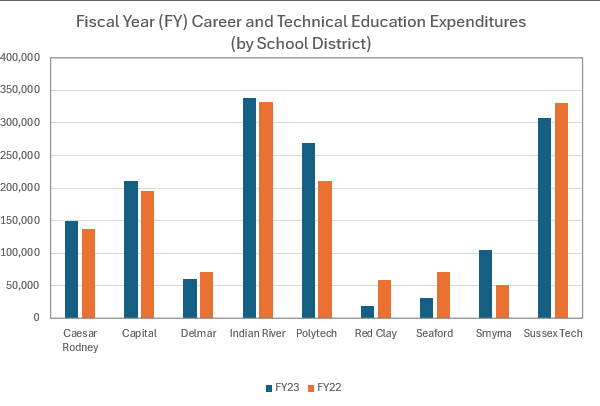
Career and Technical Education FY22, FY23
Performance Audit – Fiscal Years Ended June 30, 2022 and 2023
December 11, 2025
Sign Up For Our Audit Reports Email Distribution List
Report Summary
Background
The Office of Auditor of Accounts contracted a performance audit by Gunnip & Company, LLP to address certain objectives as detailed in the following report related to the State Career and Technical Education’s (CTE) funding to the school districts for fiscal years 2023 and 2022.
This audit was conducted in accordance with the mandate contained within 14 Del. C. § 1706, which specifies that “…Random audits [of Division II appropriation funds] shall be scheduled and conducted by the State Auditor. The Secretary of Education shall request an annual report from the State Auditor evidencing an audit schedule of 10% of the affected schools.” 29 Del. C. § 2906 establishes the duty of the Auditor of Accounts to “…conduct audits of all the financial transactions of all state agencies.”
The General Assembly provides funding for secondary occupational-vocational Career and Technical Education through House Bill 509. The State funds that support CTE are commonly referred to as “509” funds based on the title of this legislation. Local Education Agencies (LEAs) meeting certain provisions receive State “509” funds as part of the school system’s annual allocation. Delaware Admin Code provides guidance to LEAs in establishing CTE Programs of Study that are aligned to industry needs and provide equitable access, supports, and outcomes for students in grades 5 to 12.
This examination engagement was conducted in accordance with attestation standards established by the American Institution of Certified Public Accountants and Government Audit Standards issued by the Comptroller General of the United States of America.
Key Information and Findings
The audit resulted in four findings:
Finding 1 – Some instructors were missing credential support for the occupational-vocational unit division II funds being earned.
Context: Some instructors were missing the proper credentials to teach CTE courses based on the licenses
and/or certificates noted in the Delaware Educator Data System.
Finding 2 – There was inconsistency between requiring Vocational Education funds be allocated to the school that generated those funds versus the school district’s ability to include those funds as part of its Alternative Reduction Plan (i.e. aka “give back”).
Context: At least 90% of the occupational-vocational unit Division II funds, with the exception of Division II-Energy funds, shall be allocated to each school that generates these funds and expended to support the State-approved occupational-vocational courses and programs at that school. If any school district requested a waiver of the 90% requirement, then the school district should have secured approval from the Executive Director of the Delaware Advisory Council on Career and Vocational Education, the Secretary of Education, and the Controller General.
Finding 3 – It would be beneficial for the CTE Division to provide further guidance on the documentation that should support State CTE expenditures.
Context: Auditors noted that while a number of expenditures did not meet CTE Federal expenditure guidelines, after further discussions with the school districts and State Director of CTE, such expenditures were allowable under the much broader use of State CTE funds.
Finding 4 – The SDs should establish reports with line-item accounts for occupational-vocational expenditures.
Context: Auditors did not note any specific reports being utilized by the sampled school districts that tracked occupational-vocational Division II Funds (CTE Funds) by object category line items, but rather they utilized various First State Financials reports that illustrated the type of expenditures that were applied against the State CTE funds appropriation account.